Comparison · Comparisons
Best Cookieless Analytics Tools Compared
Cookieless analytics tools compared on how they count visitors, their limits, revenue tracking and price, so you can pick the right one. Checked November 2026.
· 3 min read
Cookieless analytics tools count visits without storing anything in the visitor's browser. They differ less in privacy than in what they do with the data: some stop at traffic, some add goals and funnels, a few add revenue. Here's how to compare them. How cookieless counting works explains the method and its limits.
What to check in any cookieless tool
- How visitors are identified. Usually a daily hash of IP address and user agent with a rotating salt. Ask whether the IP address is ever stored.
- What happens to returning visitors. With daily ids, someone who visits twice in a week counts twice. Check how the tool reports weekly and monthly uniques.
- Whether revenue still works. Without a lasting id, a sale on a later day can't be joined to the first visit through the id alone.
- Whether the script can be served from your domain, which reduces blocking.
The tools
| Tool | Cookieless | Self-host | Revenue | Entry price (Nov 2026) |
|---|---|---|---|---|
| Plausible | By design | Yes | Business plan | $9/month for 10k pageviews |
| Fathom | By design | No | Yes | $15/month for 100k pageviews |
| Umami | By design | Yes | Yes | Free Hobby, Pro $20/month |
| Simple Analytics | By design | No | Not on pricing page | Free hobby plan, $20/month |
| DataFair | Optional (data-cookieless) | No | Payment provider webhooks | $5.99/month at launch |
Plausible
The best-known cookieless tool: open source, EU-based, simple. Plausible vs Umami compares the two open source favourites.
Fathom
Cookieless, polished, with 50 sites on every plan. Good for people running many sites.
Umami
Cookieless, open source and cheap at volume, with a free cloud tier and easy self-hosting.
Simple Analytics
Cookie-free and EU-based, with a free plan for hobby sites.
DataFair
DataFair offers cookieless as a mode, so you choose per site:
- Cookieless: nothing stored in the browser. A daily id from a keyed hash of the day, your website, the IP address and the user agent; the IP address itself is never stored. Payments in the same day still match, because checkout links are tagged with that day's id.
- Consent: nothing until your banner gives consent, then a first-party cookie for longer journeys.
- Default: a first-party cookie.
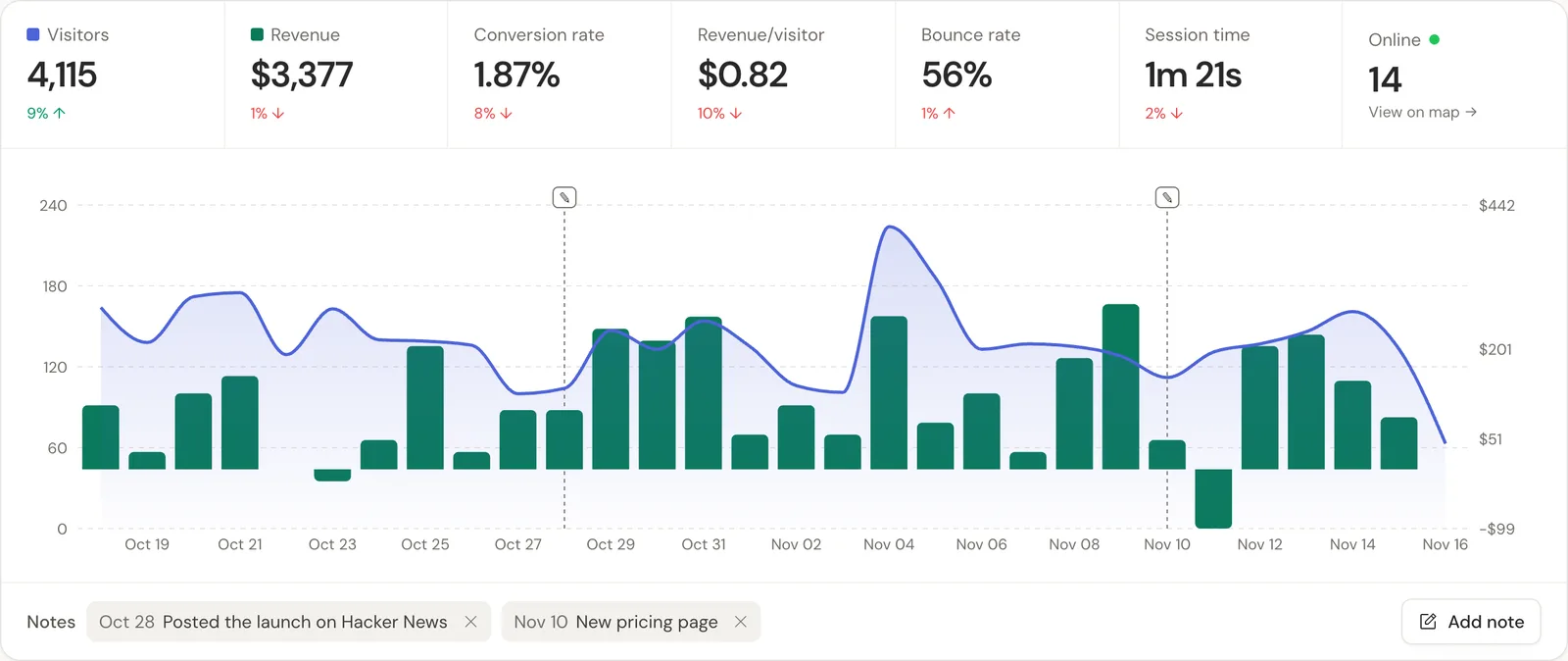
Revenue comes from your payment provider's webhooks, so every sale is recorded in all three modes. What changes is how many can be matched to a source. We make DataFair; best privacy-friendly analytics gives the wider field.
How to choose
- Simplest possible, EU company: Plausible.
- Self-host for free: Umami.
- Many small sites: Fathom.
- You sell online and want revenue by source: DataFair, in cookieless or consent mode depending on how long your customers take to buy.
Related guide: A Plausible alternative with revenue on every plan.
Questions
- Do cookieless analytics tools need a consent banner?
- For analytics alone, often not, but it depends on your jurisdiction and what else your site loads. Check with your adviser.
- Are cookieless analytics accurate?
- Daily visitor counts are close to cookie-based counts. Weekly and monthly uniques run higher, because returning visitors get a new id each day.
- Can cookieless tools attribute revenue?
- Same-day purchases, yes. Purchases on later days need another signal, such as an email the customer already used, or a consent-based cookie.